Buildings that meet higher sustainability standards continue to command increased rents across major global office markets. But how much of that premium can be attributed to sustainability, rather than other characteristics typically associated with better-quality buildings?
We analysed data from more than 2,000 offices across six global cities to establish whether green certified Grade A offices command a premium over non-certified buildings. Our research method controlled for multiple factors that influence rents, allowing us to isolate the green premium.
The findings show that today’s rental markets place measurable value on sustainable buildings, although the size of the premium varies considerably between markets globally. The largest green premiums are seen in Europe and Asia Pacific. Regulation, the availability of certified green buildings, occupier demand dynamics and broader market conditions all influence the value of green credentials.
Green premiums in Europe
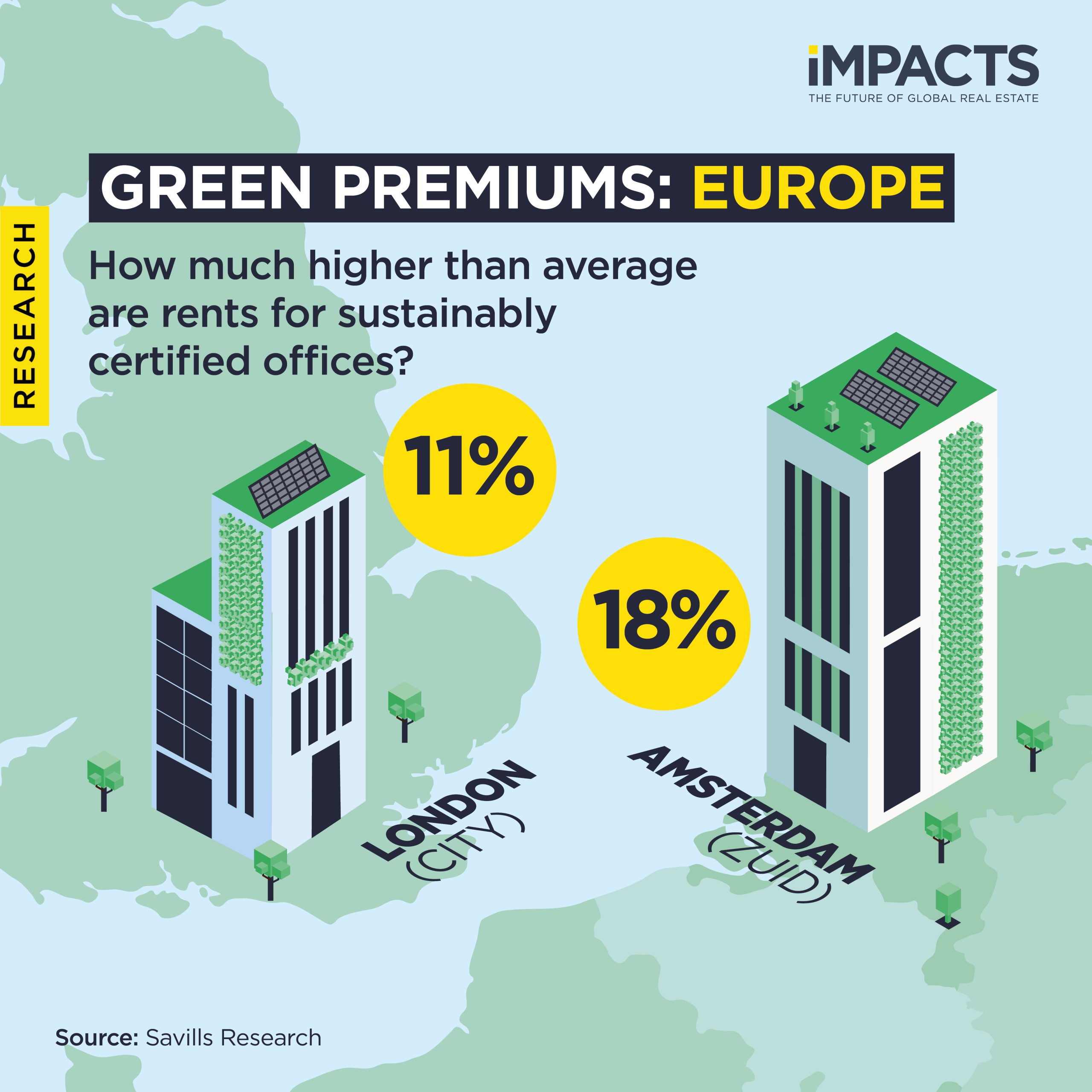
London records an 11% premium for BREEAM-certified offices, rising to 28% for Outstanding-rated buildings. Offices with higher levels of certification also benefit from longer lease lengths. Meanwhile, Amsterdam averages an 18% green premium for certified Grade A stock.
“We’re seeing a link between strong environmental credentials and both longer-term commitments from tenants and meaningfully higher rents. Sustainability is increasingly part of the leasing decision, alongside location, amenities and building quality. That’s especially the case for global corporate tenants, who are seeking to align their portfolios with long-term sustainability targets.”
Hunter Booth, Director, Central London Agency, Savills
Average lease length in London (City) by BREEAM rating
Source: Savills Research
Georgios Askounis, Director, Savills Earth
London: Green premium by BREEAM certification
Source: Savills Research
From a valuation perspective, the key question is becoming more about whether less sustainable buildings face an increasing discount. Sustainability is not simply about creating upside; increasingly, it is about preserving value and protecting against downside risk.”
Martijn Onderstal, Head of Valuation, Savills Netherlands
Green premiums in APAC
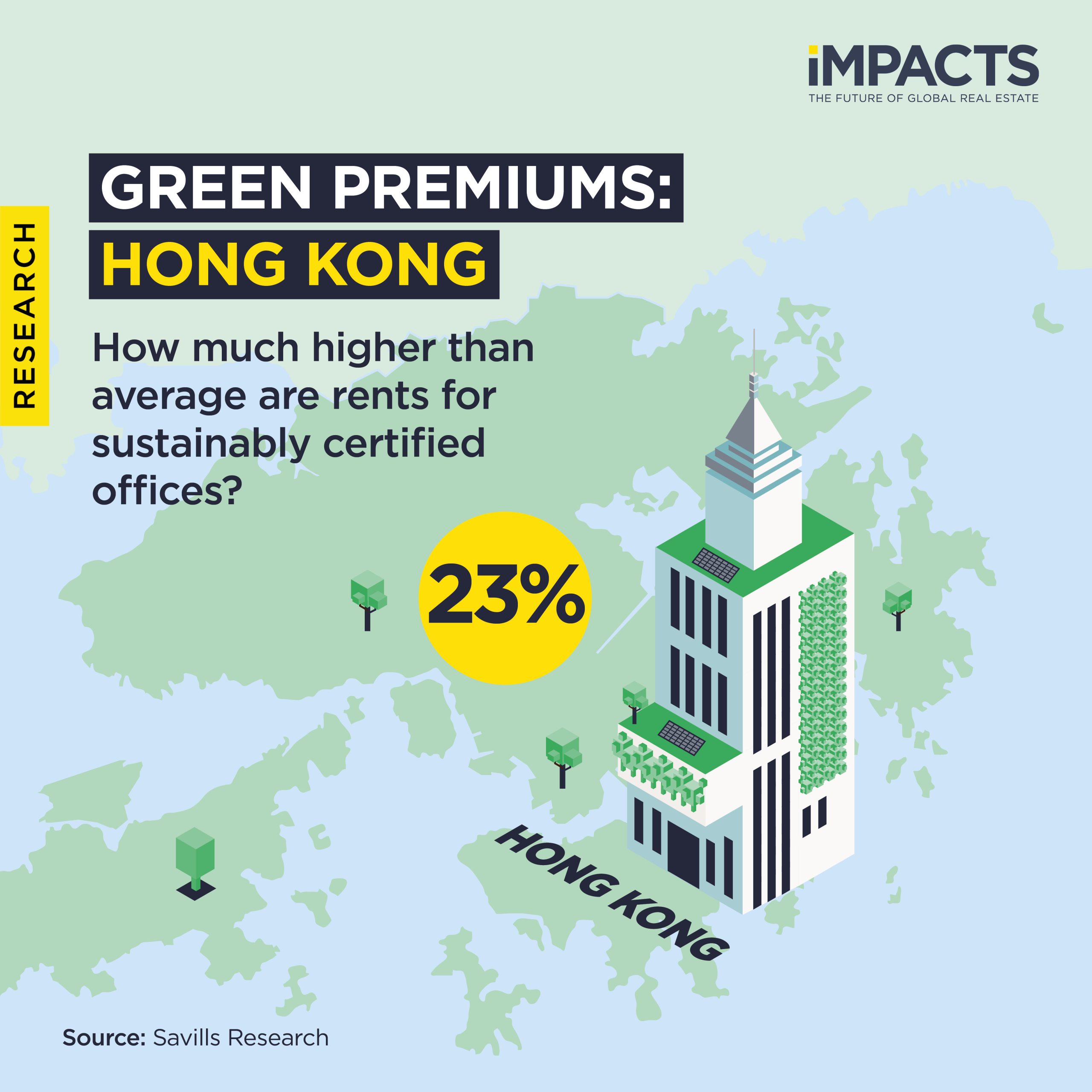
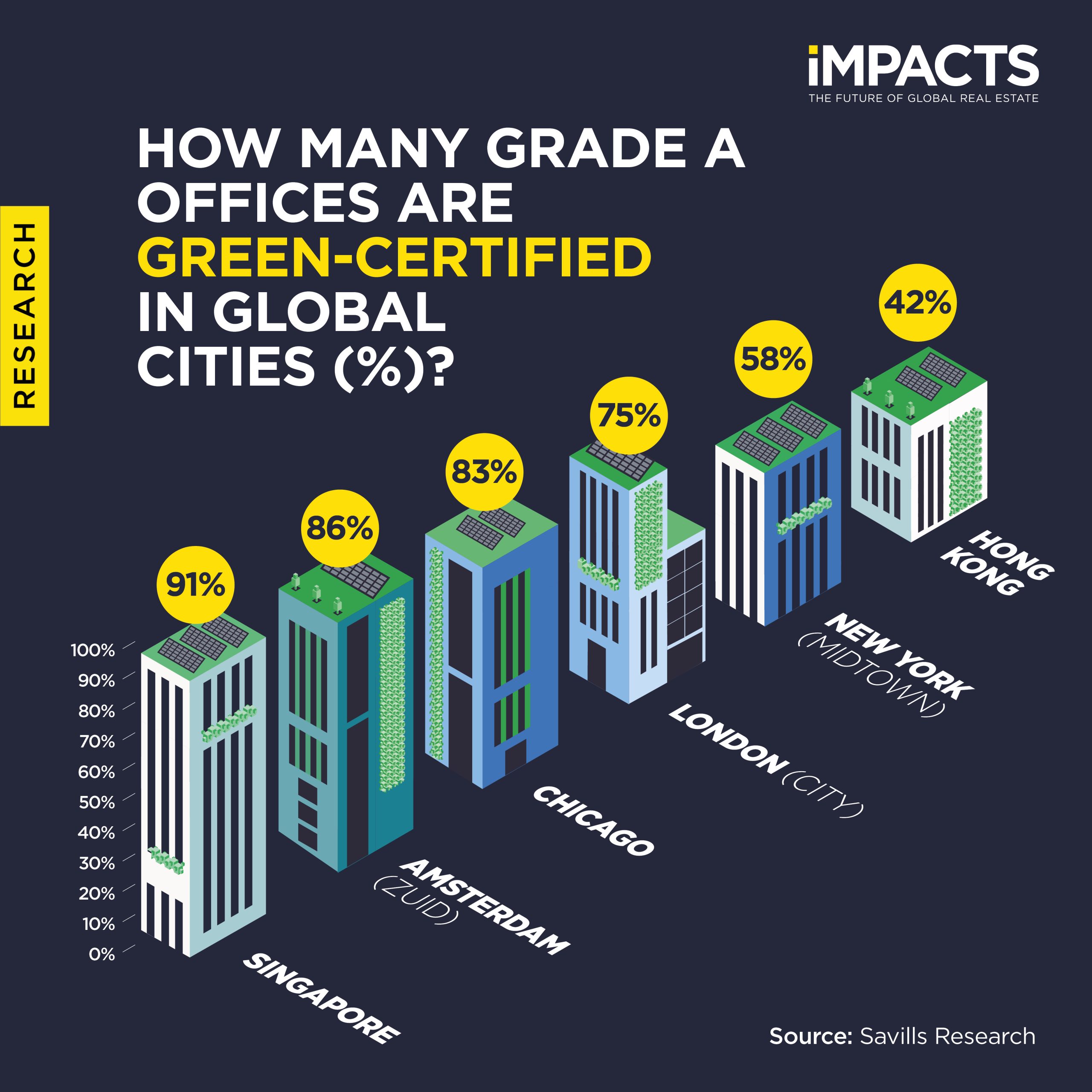
In Hong Kong, the green premium reaches 23%, reflecting the relative scarcity of green-certified space. But there’s a different picture in Singapore. With 91% of Singapore’s Grade A stock green-certified, sustainability is increasingly a baseline expectation, making it harder to isolate a rental premium in this market.
In Hong Kong, this research on green premiums provides a useful market signal. Green certification matters, but operates alongside other factors such as tenant composition, supply-demand balance, and building-specific and cyclical factors.”
Jack Tong, Director, Research and Consultancy, Savills Hong Kong
Alan Cheong, Executive Director, Research and Consultancy, Savills Singapore
Green premiums in the USA
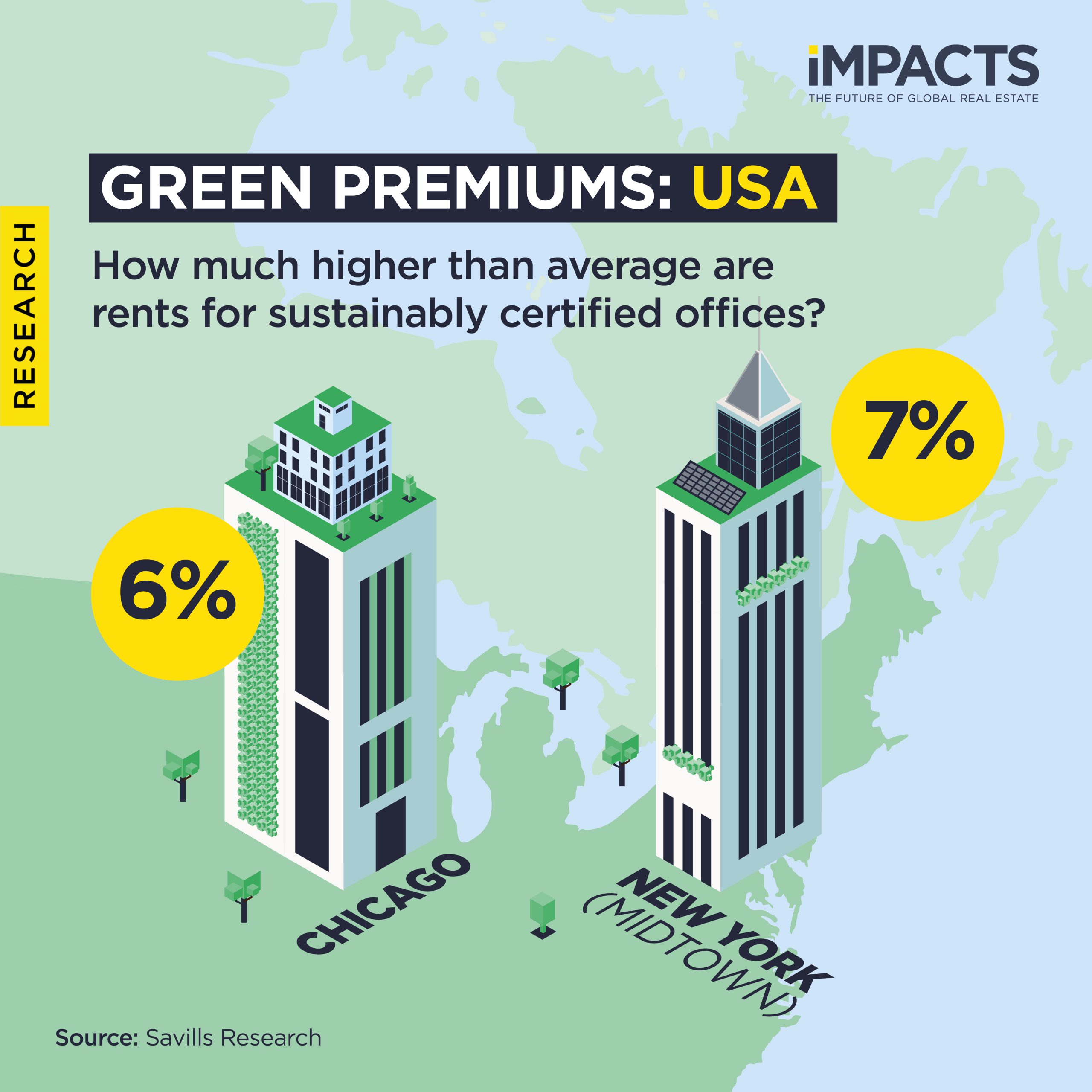
The green premium in the US is more modest: 6% in Chicago and 7% in New York. Sustainability is often seen as part of the wider quality and amenities of an office rather than acting as a standalone differentiator.
Wendy Feldman Block, Executive Managing Director, Savills US
Our research methodology
Using a bespoke, hedonic rental model, our research controlled for a range of factors known to influence office rents. These include building grade, age, proximity to major transport links, floorplate size and whether the office could be defined as a ‘trophy’ or ‘ultra-prime’ building. Green certification refers to LEED in New York and Chicago, BREEAM in Amsterdam and London, BCA Green Mark in Singapore, and LEED and/or BEAM in Hong Kong. This approach allowed us to isolate the rent premium linked to environmental credentials from other characteristics that may influence pricing.
These premiums are intended as benchmark figures, with the actual premium achieved by an individual building depending on its specific characteristics and market conditions. We examined rent data from more than 2,000 offices across six global cities: Amsterdam, London, New York, Chicago, Singapore and Hong Kong.