
The past decade has brought some of the most profound changes to working practices since the Industrial Revolution. Labour scarcity, slowing global migration and macroeconomic volatility have made finding and retaining talent more complex. At the same time, maturing digital technology has enabled companies to spread functions across different cities.
Traditionally, businesses clustered in a select few leading global cities, drawn by deep talent pools, access to capital and proximity to clients. Today, a new corporate geography is emerging. These major global cities remain important but are now part of wider office networks that support growth, provide access to talent and improve cost efficiency.
This has flipped the traditional relationship between workers and jobs: increasingly, companies are not asking talent to relocate but are moving to where they can find skills matched to their strategy. In boardrooms across the globe, corporate expansion plans are driven by the question: where can we find – and keep – the right people?
The types of cities attracting global businesses
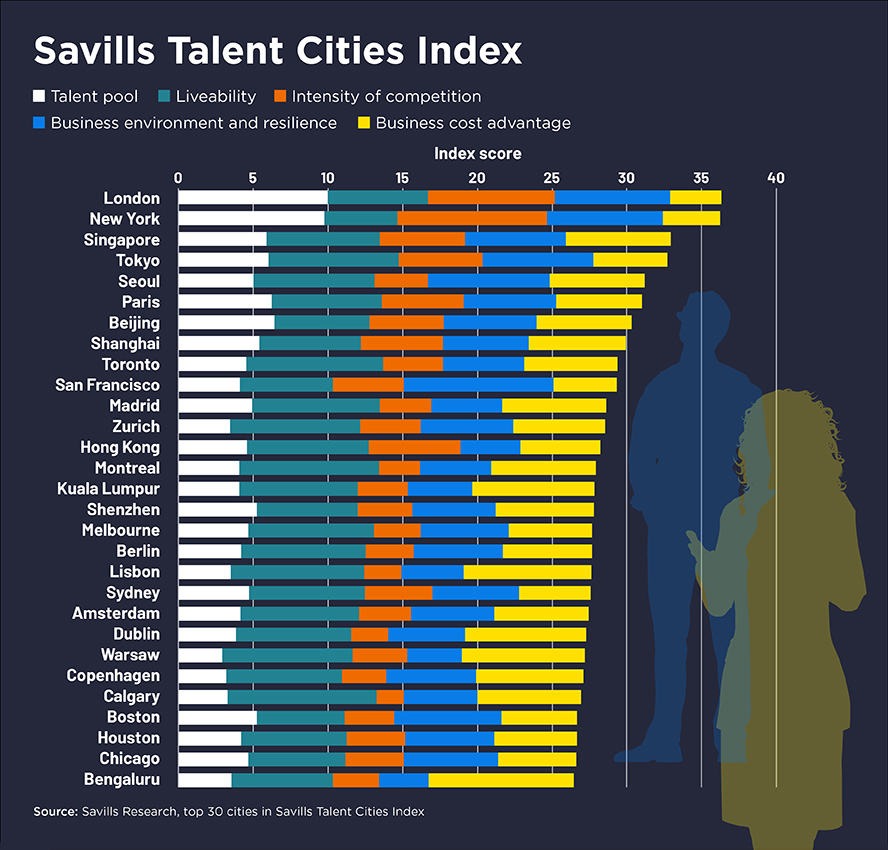
To understand the evolving role of cities, we have examined their position in the broader talent ecosystem. Our Savills Talent Cities Index analyses global business hubs according to five categories: access to talent, liveability, local competition, economic resilience and business cost advantage (including salary and real estate costs).
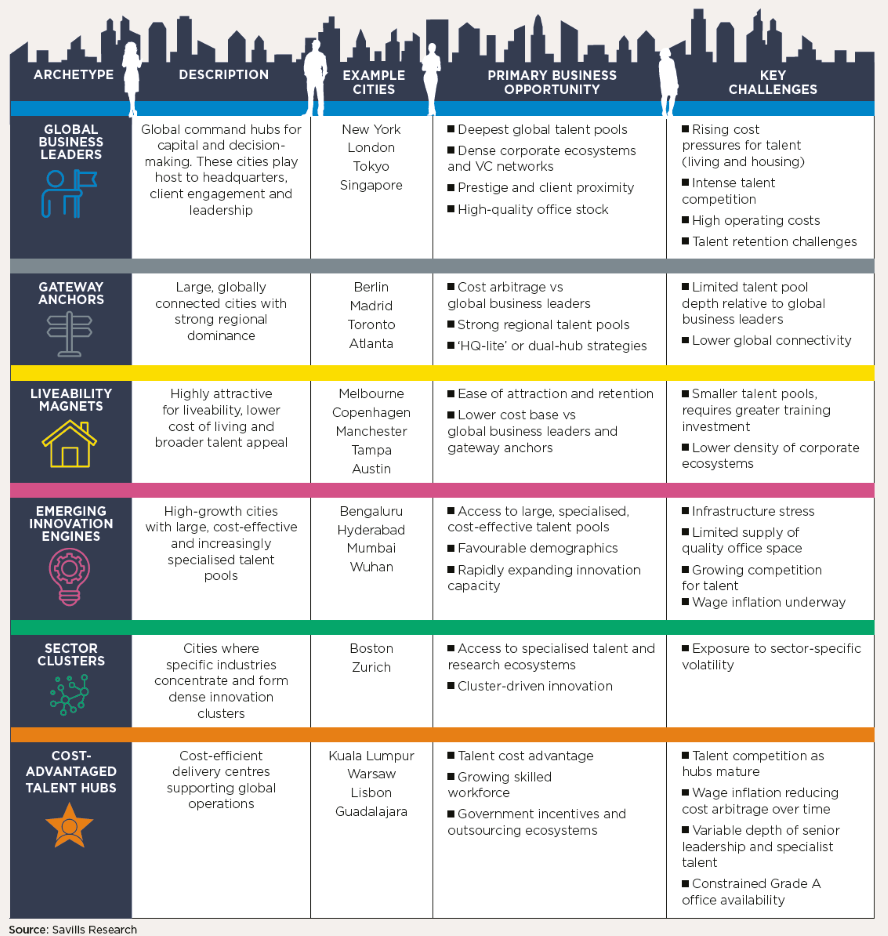
However, rather than focusing our analysis on a ranking of cities from best to worst, we have grouped them into a series of archetypes with shared characteristics. Six distinct profiles emerged.
Trends reshaping the working world
Talent competition has intensified. Our 2025 survey, conducted in collaboration with CoreNet Global, found that almost two-thirds of organisations reported a reduction in talent availability in their headquarter location, rising to 73% in the technology sector. This catalyst is driving companies’ willingness to relocate or expand into new markets to access skills.
But acquiring talent is complex: unemployment across advanced economies is close to historic lows, while ageing populations mean more workers are retiring than entering the labour market.
The cities with the highest concentrations of talent are also among the most expensive places to live and work. There is significant skills availability, but it comes with intense competition. You can hire great people, but can you afford to keep them? Are they doing their best work? In many competitive markets, long commutes and high living costs take a toll on retention and day-to-day engagement.
For many, the answer is not to abandon the global business leader cities, but to rebalance their footprint. Headquarters remain anchored in major hubs where senior decision makers can connect with key clients and raise capital, while growth, innovation and operations are increasingly distributed across talent-matched locations.
There is an inherent tension in the data. Cities that score highest for liveability tend to score lowest on the depth of their talent pools and the presence of competitor businesses. That might seem to be a weakness, but viewed through the lens of retention, less competition for staff means lower attrition, and a better quality of life means more engaged employees.
As Michelle Needles, Global Head of Enterprise Solutions, Global Occupier Services, Savills, explains: “When everyone goes to the same place for talent, there is no competitive advantage left. Instead, we find saturated hiring markets, wage inflation already underway, talent with too many options, which makes operations more fragile.”
“If your location map mirrors your competitors’, your challenges will too,” Needles adds. “The best talent strategy often involves places your competitors haven’t validated yet.”
Cities for every age
Each city archetype has a distinct demographic profile. The average age in global business leader locations is highest at 41, reflecting the seniority of the workforce – and, potentially, higher costs of living that deter younger workers from putting down roots. Liveability magnets skew younger (35), attracting mid-career professionals and families drawn to affordability and work-life balance.
These patterns are reinforced by shifting migration flows. Net migration into global business leader cities has fallen sharply – from an average of 147,000 annually in the 2000s to just 24,000 in the 2021-25 period – as workers have prioritised liveability. Meanwhile, gateway anchors and liveability magnets have seen steady increases.
Cities in focus
The shift towards a ‘talent-first’ location strategy is causing cities to move between archetypes. Locations that were once cost-advantaged talent hubs have capitalised on their talent pipelines, moving up the value chain. Others that were traditionally seen as secondary or tertiary cities are becoming prominent hubs in their own right. Here are three cities on the move.
North America: Toronto
Our research identifies Toronto as a gateway anchor: a city that offers strong regional talent alongside cost savings. Canada’s largest city has become a focal point for global companies seeking skilled and engaged talent. Toronto ranks fourth for liveability in our Savills Talent Cities Index, with many amenities, short commutes and reasonably priced housing.
A key structural advantage for Toronto is Canada’s migration policy. Canada tops our Ease of Migration Tracker thanks to its points-based immigration system, helping companies to recruit international talent more easily.
According to Devon Munos, Senior Vice President, Head of Americas Research, Savills, leasing activity in the city has been well above average for the past three years. She says that the first quarter of 2026 has been “structurally transformational”, with record levels of deals.
Toronto is the city of choice for many tech firms looking to grow their operations. Microsoft has expanded its engineering team in the city, Uber has built an AI research centre and Google is developing a large-scale campus.
“Global employers are drawn to Toronto’s well-educated workforce and its relative affordability, which support resilient and scalable operations,” says James Butchard, Executive Vice President, Savills Downtown Toronto. The city may be a gateway anchor today, but it could be a global business leader of tomorrow.
Elsewhere in North America, Dallas and Atlanta have become increasingly attractive locations. These cities offer a compelling mix of lifestyle, affordable quality housing and career opportunities. Nashville is also emerging as a strong regional hub, with Starbucks recently announcing its new $100 million headquarters in the city.
Savills Ease of Migration Tracker
Source: Savills Research
Asia-Pacific: Bengaluru
Formerly a cost-advantaged talent centre, Bengaluru (formerly Bangalore) has taken on the more strategic role of an emerging innovation engine. In recent years, it has become a hotspot for the global technology industry and the country’s primary base for global capability centres.
Naveen Nandwani, Managing Director, Commercial Advisory and Transactions, Savills India, has been working in this market for 20 years. “Bengaluru and Hyderabad are moving beyond their traditional roles as outsourcing centres to become deeply embedded within global operations, taking on R&D and innovation-led roles,” he says.
Bengaluru has abundant tech talent, thanks to its youthful population and network of prestigious engineering colleges. The city is now home to the sprawling campuses of Infosys, Accenture, Amazon, Microsoft and more. According to Nandwani, domestic migrants – drawn by this concentration of tech companies – account for 60% of the population. Google is currently building a new 20,000-employee campus, which will attract even more skilled workers to the city.
Bengaluru ranks second in our Index for business cost advantage, giving it the edge over cities such as Mumbai. But in the short term, its growth has created infrastructure problems that are key for businesses to understand and navigate.
Beyond Bengaluru, across India, Gurugram, New Delhi and Mumbai are strengthening their position as global innovation hubs, with inflows of venture capital funding into these cities increasing 400% in the past decade.
Momentum is also building in Seoul, with its highly educated workforce and deep expertise in AI, semiconductors and gaming. In China, Wuhan is emerging as a strong innovation engine, supported by a growing pipeline of highly skilled graduates.
How Indian innovation engines compare: scores from the Savills Talent Cities Index
Source: Savills Research using PitchBook data, reflects annualised five-year average from 2000–2025. Note: Data has not been reviewed by PitchBook analysts. Scale break used for San Francisco to allow comparison across remaining cities
Europe: Manchester
Manchester offers a combination of cost competitiveness, a strong talent pipeline and high liveability – earning it a liveability magnet classification. It has experienced an unprecedented residential development boom in recent years, meaning employees can live in the city centre while benefiting from lower outgoings compared with London.
“The local government is investing in public transport, cycling infrastructure and notable mixed-use developments such as Spinningfields, Circle Square, NOMA and Mayfield,” says Andrew Cooke, Director, UK Tenant Representation, Savills. He adds that these projects are creating vibrant new urban neighbourhoods.
Manchester is also a major academic hub, with over 120,000 higher-education students – one of the largest concentrations in Europe. Critically, it holds onto its talent: 65% of its graduates decide to call Manchester their permanent home.
“The city has a diverse occupier base: The Hut Group, AO.com, AutoTrader, The Co-Op and Boohoo were all born here,” says Cooke. Other notable occupiers include German fashion and sports company Puma, which moved its UK headquarters to Manchester in 2025. Travel giant Booking.com’s Manchester campus is now the company’s second-largest international office after its Amsterdam HQ.
Despite the city’s smaller talent pool, fewer business competitors means the average tenure of employees in Manchester is 21% higher than in London. Our research shows the city could outgrow its classification as a liveability magnet, taking on the characteristics of a gateway anchor over the medium term.
Elsewhere in Europe, Barcelona is also gaining traction within an evolving talent landscape. Julia Moore, Director, Corporate Account Management, Global Occupier Services, Savills has seen increasing interest from multinationals in the city as well as in Madrid and Lisbon. “Barcelona has built a strong reputation for attracting skilled professionals drawn by its quality of life and growing business ecosystem” she says.
Overall, key business hubs on the Iberian Peninsula scored highly for lifestyle, with Lisbon, Barcelona and Madrid all ranking in the top 15 of our Savills Talent Cities Index for liveability.
Companies form talent networks
The way companies think about their operations across the world is changing. They are still investing in global business leader locations as a base for senior talent but increasingly complementing them with networks of locations from across the city archetypes to provide the talent to deliver their corporate strategies.
“Forward-thinking companies are defining a talent-centric location strategy from first principles,” says Needles. “They are selecting the types of cities where the right talent wants to be – and will continue to want to be.”
How archetypes compare: scores from the Savills Talent Cities Index
Global Business Leaders
Gateway Anchors