What’s the social value of real estate? What contribution do buildings make to the community, and how can this be measured?
These aren’t straightforward questions to answer. Social value arises when buildings, places and infrastructure contribute to environmental, economic and social wellbeing, improving quality of life for people.
But social value is, by its nature, grounded in the local. Wherever you are in the world, you can measure carbon consistently by the tonne and energy by the kilowatt-hour. But social value means different things in different places.
The language used to describe it reflects these differences. While ‘social value’ is the common term in England and Australia, in the United States ‘community benefit’ is often used instead. In Italy, the most widely used measure looks at cultural heritage.
How social value is currently measured
Social value measurement is less established than its environmental counterpart and its adoption across the real estate industry is more uneven. The problem today is not a shortage of frameworks or labels: it is that they do not all measure the same things, or assess a building’s impact on the same groups of people.
“Any real estate asset affects four groups,” says Wesley Ankrah, Director, Social Value, Savills. “Those embedded in a place, who live in or around it; those employed in a building; those who are engaged with it as visitors or users; and the ‘detached’ wider public. While the last group may never set foot inside the building, they are affected by it all the same. Including them in social value measurement is a first step to engagement.”
Four pillars of social value: the people a building affects
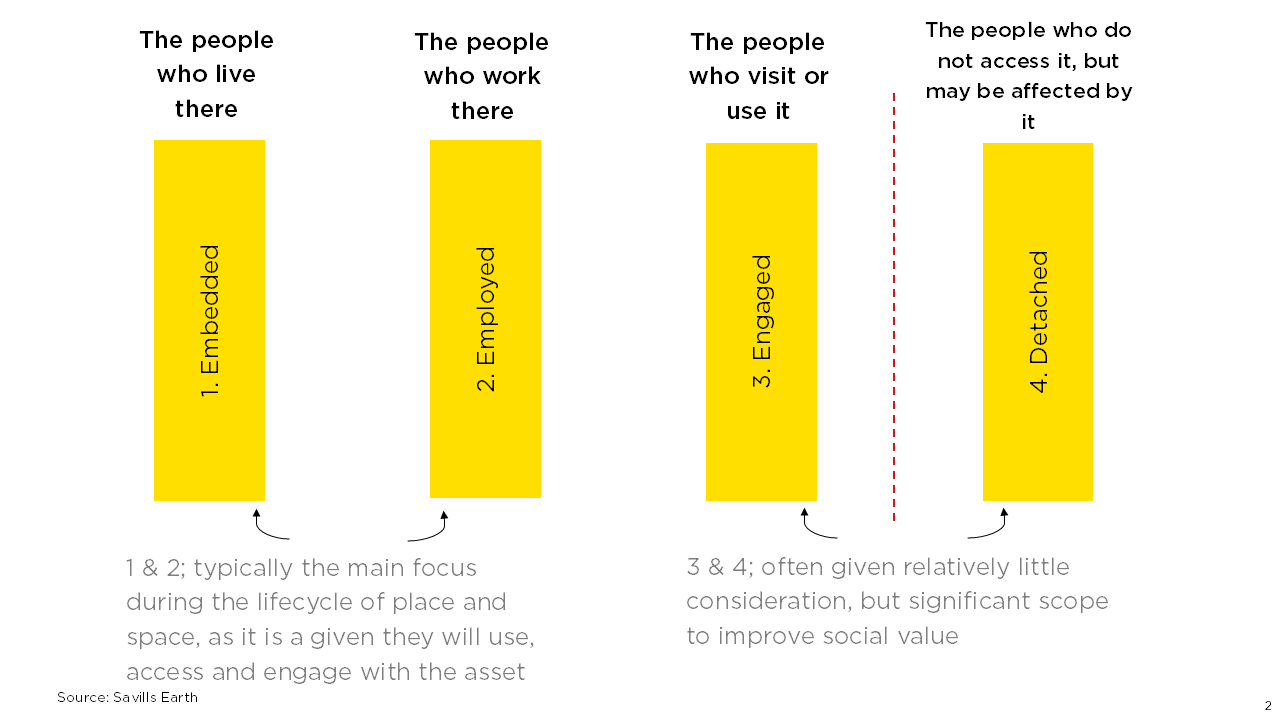
We analysed 30 frameworks for measuring social value that are in use around the world. These range from valuation methodologies such as HACT’s UK Social Value Bank to building certifications such as WELL and reporting standards such as GRESB. Our research assessed each framework against the four groups an asset affects to understand its scope and who it measures.
We found that measurement focuses on the groups that are easiest to identify and count: the people employed in a building, and those embedded in or around it. Beyond the property itself, the analysis thins out sharply. While 80% of frameworks measure the impact on those employed in a building and 60% the effects on those embedded in or near it, only 47% measure the engaged group. And just 27% measure the impact on the wider community – those ‘detached’ from the building or scheme.
Which groups does measurement cover?
Analysis of 30 global frameworks
Source: Savills Research
Building certifications are the tool that real estate uses most heavily to measure social value, but they also have the narrowest reach. A certification rates the asset, not its surroundings, so the wider public falls outside its scope almost by definition.
Frameworks that convert non-financial outputs (such as the jobs created by a building) into monetary equivalents reach furthest across the four groups, but are less often linked to asset performance. The real constraint, then, is less about agreeing a common unit than deciding who gets counted at all.
The importance of standard principles
While measurement tools cannot be easily standardised, the principles behind them can. The challenge for the industry is to set common principles – and stick to them.
That work is already underway. “Principles are the common language,” says Olivia Sutcliffe, Associate Director, Social Value, Savills. “In practice, that means setting a baseline before work starts, defining what matters with the community rather than for it, and measuring right through to long-term stewardship. And stay responsive: the community in 10 or 20 years’ time, when a scheme completes, may look very different from the one you started with.”
The commercial case: demand, risk and resilience
But measurement means little without a commercial rationale. “The question is no longer whether social value matters, but how different markets are starting to price it,” says Martijn Onderstal, Head of Valuation, Savills Netherlands. “Social value becomes real estate value the moment occupiers, investors and lenders start making decisions based on it.”
Value comes not solely from the social outcome itself, but from its effect on cashflow and risk. “Social value is often treated as an intangible benefit, but in reality it influences some of the most tangible drivers of value: tenant demand, occupancy risk and long-term resilience,” Onderstal adds. “Buildings that care for people are increasingly the buildings that attract capital, retain occupiers and outperform the market.”
For investors, social value is a way of understanding an asset’s relationship with the society around it. “A social value lens uncovers commercial risks and opportunities that might otherwise be overlooked,” says Sarah Thorley, Associate Director, Social Value, Savills. “A robust approach to community impact can attract and retain occupiers, support access to preferential lending and impact-led capital and, ultimately, enhance long-term asset value.”
But the commercial rationale is a catalyst, not the whole case. Better measurement should also capture social outcomes that conventional appraisal misses entirely, which is a further argument for widening the lens beyond the people who are the easiest to count.
From social to societal value
The next step is joining up measurement across social, environmental and economic outcomes; linking asset-level data to the communities affected; and bringing in stronger governance. That is where social value starts to become societal value.
The frameworks the real estate industry relies on are good at counting the people it can see, but the real opportunity lies in measuring those it cannot. The aim isn’t comprehensive measurement for its own sake: it is to make sure material impacts aren’t excluded just because they fall beyond the property line or are harder to count.
“The greatest challenge is more than simply counting people, it is understanding the impact on their lives,” Ankrah says. “An apprenticeship offered to someone with social and economic advantages already in place is currently counted the same as one offered to someone from a disadvantaged background – though what it changes for each person is not remotely the same.”
Extending and deepening the measurement of social impact would give the sector a fuller view of the value real estate creates – not just for those inside the building, but for the places and communities around it.