
The recovery in global real estate investment markets has continued into 2026. Around $500 billion was deployed in the first half of the year, a near 20% increase year-on-year.
Despite a hit to sentiment stemming from the conflict in Iran, our modelling suggests this growth is set to continue. Global investment is forecast to reach $1.2 trillion in 2026, which would be a 16% increase on the year.
Global investment forecast
Source: Savills Research using MSCI RCA and Macrobond. Excludes development sites
Note: global real estate investment activity now includes Data Centres
All regions are forecast to record moderate growth over the coming years. We expect Asia Pacific to lead the global expansion in 2026, driven by strong activity in Singapore and Greater China. The latter market is showing signs of bottoming out as repriced assets attract renewed investor interest. However, growth in Asia Pacific is likely to slow next year as the recovery matures, while higher interest rates weigh on markets such as Japan and Australia.
In Europe, investment is forecast to rise moderately this year before accelerating in 2027. Growth in peripheral markets, particularly Southern Europe, is currently driving activity, with core markets expected to come back into focus next year. Meanwhile, North America is set to continue delivering steady growth. It remains a key market for major capital allocators thanks to its unparalleled size and liquidity.
Real estate capital markets weather another storm
We remain in the midst of a stop-start recovery. While it continues to trend upwards over the long term, it has been repeatedly interrupted by bouts of macroeconomic volatility. Most recently, events in the Middle East have weighed on markets through the spillover effects of increased commodity prices, upward pressure on interest rates and a fall in economic sentiment.
Last year, President Trump’s Liberation Day tariffs were widely viewed as a potential inflection point for the recovery. After a slowdown in momentum during Q2 2025, however, the second half of the year proved much stronger, with investment activity ending 2025 18% higher than 2024 levels.
Real estate markets are showing increasing resilience to external shocks as investors become more accustomed to transacting through periods of volatility, and continue to focus on the fundamentals.
Global investment is increasingly resilient
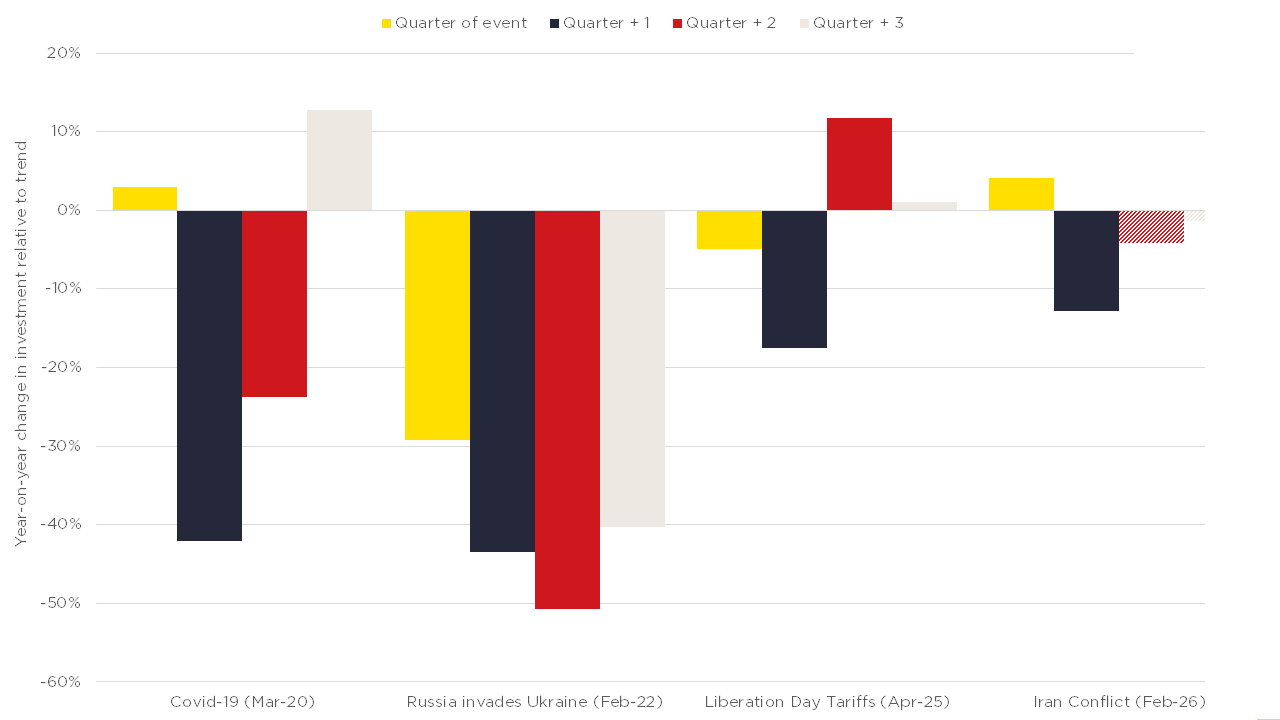
Source:Savills Research using MSCI RCA and Macrobond. Excludes development sites
Note: Trend based on preceding four-quarter moving average. Shaded bars represent forecast data
The investment recovery broadens across sectors
Recently, the market has been characterised by a rising share of trophy asset transactions, portfolio sales and large-scale M&A activity. This points to a more selective investment environment, but also demonstrates the conviction and depth of institutional capital.
This is particularly evident in sectors underpinned by long-term structural drivers, such as data centres, residential (particularly senior housing) and self-storage. It’s no coincidence that many of these are operationally intensive sectors, in which scaling through individual asset acquisitions can be challenging and established platforms often offer a more attractive route to growth.
But that’s not to say the recovery is confined to alternative sectors. Investment has also rebounded significantly across ‘old economy’ sectors, where a rebasing in pricing has created attractive entry points for investors. Office and retail continue to progress through a cyclical recovery, supported by limited new supply in many markets and signs of stabilising occupier demand. This, too, has contributed to the rise in trophy asset sales; however, there remains some polarisation across locations and asset quality.
Liquidity improves on sell- and buy-side
Looking ahead, this resilience is expected to continue, although much will depend on some stability in the wider macroeconomic environment. Ultimately, the recovery in capital markets has been underpinned by improving liquidity on both the sell-side and buy-side, and this will continue to drive activity.
On the sell-side, a growing number of fund exits and an approaching wall of loan maturities are creating opportunities for assets to change hands, increasing transaction activity and allowing capital to be recycled through the market.
At the same time, buyer demand remains well supported. Debt capital is widely available. Stable institutional allocations to real estate, alongside an improving performance across multi-asset investment portfolios, have generated a positive denominator effect and given investors greater capacity to deploy capital.
Real estate also continues to offer compelling relative value compared with other asset classes, as well as important diversification benefits in an increasingly volatile investment landscape. Constrained development pipelines are limiting future supply growth, while strong income continues to support total returns. Together, these factors suggest the foundations for further recovery remain firmly in place.