
Since ChatGPT’s launch in November 2022, AI adoption has spread rapidly across consumers, businesses and public institutions. While the technology is still early in its adoption curve compared with previous innovations, the AI models that will power this transformation are being developed and trained now.
This rapid growth is fuelling record demand for data centres, the AI economy’s clearest impact on real estate. Data centres attracted more than a fifth of global greenfield foreign direct investment (FDI) by project value in 2025, according to UNCTAD, making them among the largest recipients of new foreign investment worldwide.
But data centres have very particular locational requirements, and growth is limited by the ability to deliver them, rather than investment appetite.
The data centre sector today
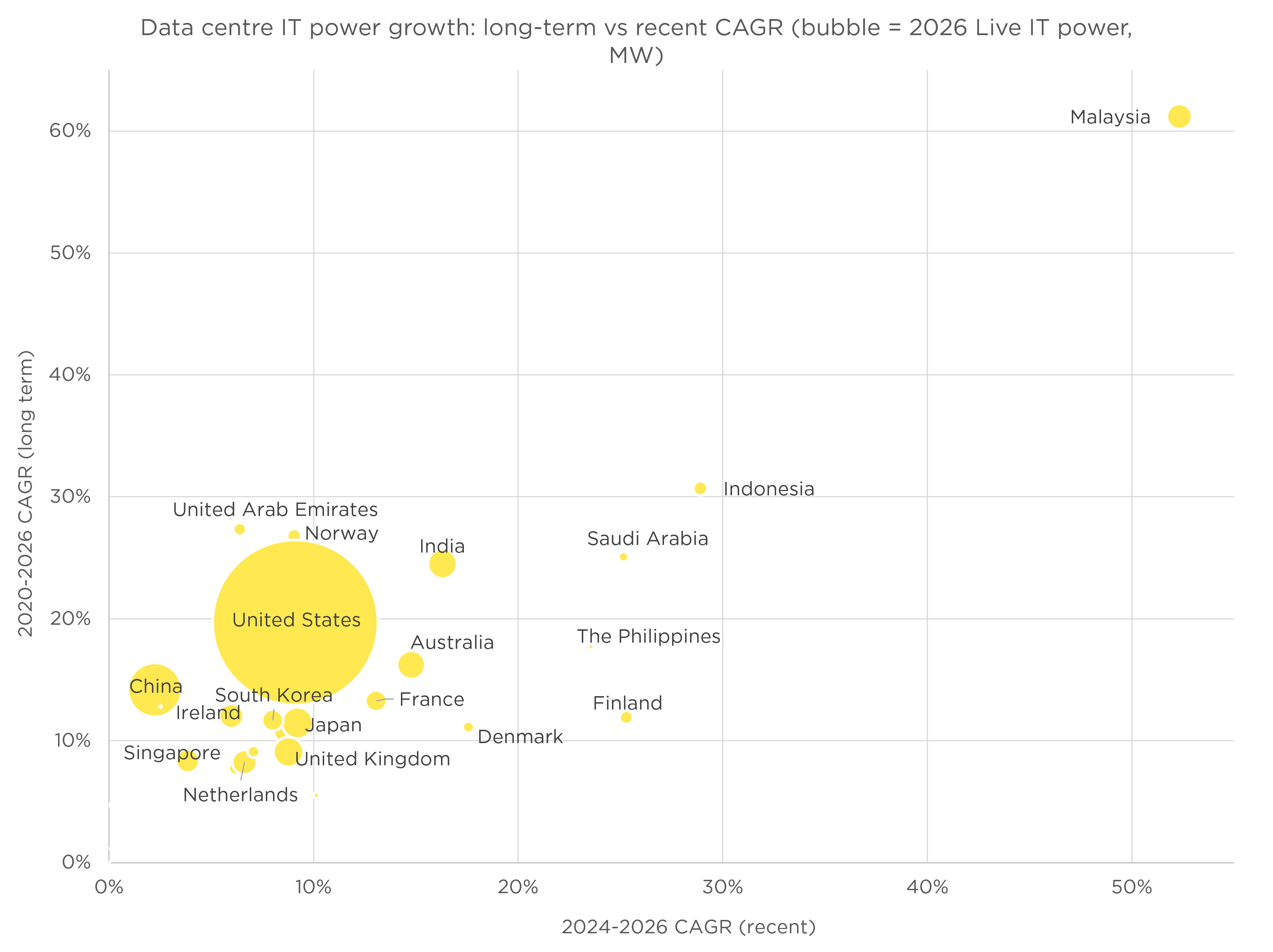
With around 50GW of live IT power, the United States is the dominant global market by data centre capacity. China is in second place. Japan, the United Kingdom, Germany, Ireland and the Netherlands are also large, mature markets with meaningful scale, but recent growth has been more modest amid rising grid access constraints. But these markets’ established ecosystems, connectivity and customer depth mean they remain important, even as building new data centres becomes harder.
A new wave of high-growth markets has also emerged. Malaysia stands out, having seen substantial build-out from a very low 2020 base. Johor Bahru, located just across the causeway from land- and power-constrained Singapore, has been a particular beneficiary. India and Australia have also grown rapidly, becoming markets of meaningful scale.
Indonesia and Saudi Arabia are also scaling rapidly from small bases. While still modest in absolute size, they have some of the steepest growth trajectories after Malaysia. The Philippines is another Asia Pacific market with strong recent momentum. In Europe, Finland has recorded significant growth since 2024, helped by its power availability, renewable energy and cooling efficiency.
Data centre capacity growth
Source: Savills Research using DC Byte
Note: Capacity and growth figures refer to live data centre capacity, with growth rates calculated over the relevant period. Broader estimates suggest total Chinese data centre capacity may be substantially higher.
Top ten fastest-growing data centre markets
By recent growth in live IT power, 2024-2026 CAGR
Source: Savills Research using DC Byte
What are the constraints on delivery?
Power is now the primary factor in data centre development, in particular, grid access, where connection lead times can far exceed build time. Developers increasingly go where grid capacity is available, rather than simply following demand. As AI workloads grow more power-intensive, energy costs are decisive too: they shape where capacity can be built and whether projects remain viable.
Water availability, climate conditions, specialist labour and local consent are also increasingly important to delivery.
The Power and Place Index
Our Power and Place Index benchmarks 54 global markets across four pillars. It focuses on the physical and delivery constraints – power, water and climate – that increasingly determine where data centres can actually be built.
The index highlights the cities where data centres can be delivered most readily given physical and development constraints. It is an indicator of feasibility rather than demand. Tellingly, many of the places that currently host the most data centres do not appear in the top 25, because they have run into physical limits around power, water, climate and planning. The opportunity instead lies in secondary and emerging markets with more capacity.
The four pillars
Weightings and components
Savills Power and Place Index: top 30: future data centre development potential
Source: Savills Research using Ember, World Resources Institute, International Telecommunication Union, Turner & Townsend, Oxford Economics, GlobalPetrolPrices.com electricity prices, WeatherOnline and Savills specialists
Four clusters of data centre growth
The Power and Place Index points to four clusters of markets that could lead the next wave of data centre development. Each has a distinct mix of power, physical and delivery advantages.
Nordic low-cost renewable power cities
Oslo leads the Power and Place Index, with Stockholm (3rd) and Helsinki (6th) close behind. These cities combine abundant renewable and self-sufficient power with some of the lowest electricity costs in the index. They also have relatively unconstrained grids and supportive planning policies, while a cool, water-rich climate eases the physical demands of cooling.
Norway in particular combines a hydropower-led system and positive power balance with a cool climate and strong connectivity, giving it a low-carbon, low-cost edge for power-intensive AI workloads. Finland shares many of these strengths, pairing plentiful low-carbon power and a naturally cool climate with available land and a beneficial planning environment.
“For AI-driven data centre growth, the Nordics offer one of the clearest delivery propositions globally,” says Rupert Duckworth, Associate Director, EMEA Data Centre Advisory, Savills. “The region has increasingly become a focus for large-scale, AI-oriented development – with significant new campuses now progressing.”
Power-rich hubs in the United States
Led by Dallas (2nd), Atlanta (4th), Chicago (7th) and Washington DC (10th), these markets benefit from power availability, developed fibre networks, permissive planning and strong construction feasibility.
Texas is emerging as one of the US markets with the greatest delivery potential. It benefits from abundant land, access to natural gas and renewable generation, a comparatively flexible power market and the ability for some operators to pursue on-site or behind-the-meter generation. The challenge now is not demand but prioritisation. ERCOT, which operates the grid across most of Texas, has tightened how it assesses connection requests. Those with secured sites, credible power strategies and capital in place are best placed to move quickly.
Southern European challenger cities
Porto (5th), Marseille (8th) and Malaga (11th) offer lower-cost power by European standards. They have more permissive planning regimes and less competing demand than some of the region’s more established hubs. Porto combines renewable power with strong connectivity as well as more room to secure land and capacity, illustrating how smaller cities can move from peripheral to strategic on the data centre map.
This pattern extends across Europe, with several AI projects being delivered further away from the major metros in locations where a faster route to significant power can be secured.
Low-cost, high-headroom Asia
A cluster of emerging Asia Pacific cities stands out for pairing cheap power with grid headroom, the combination that increasingly decides where new capacity can be developed. Led by India’s two hyperscale hubs, Mumbai (12th) and Bengaluru (14th), this cluster extends across the region to Johor Bahru in Malaysia (18th) and Ho Chi Minh City in Vietnam (27th), where some of the cheapest electricity in our index meets supportive planning. Their appeal rests on low electricity costs and the potential to scale, but in parts of the region the stability of power supplies and the pace of grid development remain limiting factors.
“Singapore’s long-running restrictions on new data centre development redrew the map across the region, and the opportunity is now spreading,” says Nicholas Tuan, Director, Savills APAC Advisory. “Johor Bahru led the overflow, but the momentum is shifting to Bangkok. Hong Kong remains tightly constrained, yet tellingly the hyperscalers are all still there, and new supply is opening up in the north. Elsewhere in the region, even where grids aren’t yet ready, capacity will follow wherever power and land align.”
The greater picture: delivering for communities
Demand for data centres is not in doubt. But the harder question is where they can actually be built. Answering this will require close collaboration between operators, utilities, governments and local communities, particularly where AI workloads place new pressures on grids and resources. Climate risk compounds the challenge: higher temperatures, water stress and extreme weather will increasingly shape where capacity can be delivered and run reliably, and communities and governments will be asking whether development will exacerbate existing issues.
When planned effectively, data centre growth can support grid investment and renewable energy demand, enable heat reuse and develop local skills. But as digital infrastructure becomes more visible in the built environment, the sector’s long-term success will depend on delivering capacity efficiently while managing its wider impact on power, resources and local areas.